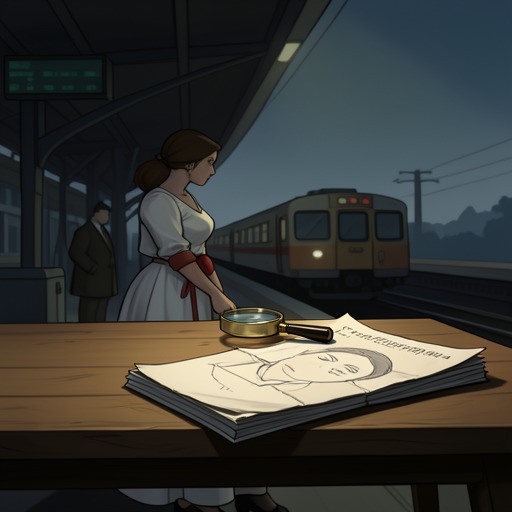
1966 accident photograph album
The Girl with the Dragon TattooThe 1966 accident photograph album is the central visual record of the day Harriet Vanger disappeared. It begins with her last known photograph at the Children’s Day parade in Hedestad and then follows the catastrophe on the Hedeby bridge, where a collision, an overturned oil tanker, injured drivers, emergency services, reporters, and sightseers created a public crisis that concealed a private disappearance. Its decisive importance lies in the contradiction between the abundance of images and the persistence of what nobody understood: the album contains approximately 180 photographs, yet the truth remains hidden in timing, absence, and a face mistaken for another.
Composition and Historical Setting
The album was assembled from five rolls of photographs taken on the day Harriet Vanger vanished. Its opening image shows Harriet in the crowd at the Children’s Day parade on Järnvägsgatan in Hedestad, roughly two hours before she disappeared. The remaining photographs document the bridge accident rather than Harriet herself. A professional photographer captured the overturned tanker, the wrecked car, spectators on the foreshore, and the frantic efforts to rescue Gustav Aronsson, who was pinned inside his vehicle. Heating oil spurted from the damaged tanker, the trailer hung over the bridge edge, and police, an ambulance, the rescue squad, the fire brigade, reporters, and sightseers converged on the mainland side.
The accident made the bridge a traffic bottleneck and drew public attention toward one dangerous, highly visible scene. On the island side, people struggled to free Aronsson while the formal family dinner approached. The album therefore preserves two simultaneous realities: a spectacular emergency that occupied everyone’s sight and a disappearance that could occur behind that collective concentration. Its photographs do not merely illustrate the accident; they record the conditions under which the accident became cover for movement elsewhere.
Henrik Vanger preserved the album as both evidence and memorial. The first photograph was an odd inclusion because it was the only image not concerned with the bridge, but it was also the last picture of Harriet that existed. Henrik had reportedly looked at it countless times as a sorrowful reminder that he would never see her again. For him, the album held grief in visual form; for Mikael Blomkvist, it eventually became a document whose ordering and overlooked details required renewed examination.
The Window and the Problem of Time
One photograph shows Harriet’s bedroom window closed; a later image, taken between approximately 3:40 and 3:45 p.m., shows it open. Henrik Vanger had asked the family who opened it, and nobody admitted doing so. The change converts an apparently static house into a sequence of possible movements. The window is not proof by itself of what happened to Harriet, but it establishes that someone entered or occupied a space associated with her during the crucial interval.
The album’s evidentiary force emerges only when the photographs are read chronologically rather than sentimentally. After six months of fruitless thought, Blomkvist returned to the opening parade photograph and recognized that its placement had caused viewers to look past it toward the more dramatic bridge images. He later examined negatives frame by frame and discovered that the collection was incomplete: approximately thirty blurred or poor-quality photographs had been omitted, perhaps by the young Nylund or by the person who copied the collection. One recovered image showed that the window had been opened between 3:10 and 3:15 p.m., precisely when Harriet vanished. The apparently minor discrepancy became a temporal marker for the disappearance.
The album thus presents a crisis of visibility. The bridge is photographed from multiple angles and at close range, while the decisive action remains outside the most obvious field of attention. The crowd, the emergency, and the family’s assumptions organize what viewers notice. The truth is not absent from the archive so much as buried within its sequence, its omissions, and the habits of those who inspect it.
Misidentification and the Family Archive
The album also exposes how easily visual evidence can preserve an error. In photographs from the family dinner held after the bridge drama but before anyone knew Harriet was missing, Cecilia Vanger appears beside a blonde woman in an identical light-coloured dress. The two women resemble twins. Blomkvist realizes that the woman previously assumed to be Cecilia at Harriet’s window was actually her younger sister, Anita Vanger, who was then living in London. Cecilia and Anita had rarely, if ever, been photographed in the same frame, and no one had thought to question the assumption that the recurring figure was Cecilia.
This discovery changes the meaning of earlier observations. The photograph had seemed to place Cecilia Vanger near Harriet’s room, but the visual record had concealed the sisters’ interchangeability. Henrik Vanger could distinguish them, yet Blomkvist and Lisbeth Salander had mistaken one for the other because distance, black-and-white reproduction, and repeated family imagery made identity appear self-evident. The album therefore demonstrates that photographs can preserve appearances while weakening recognition: they show bodies clearly but do not automatically explain who those bodies are, why they are present, or how they move through the scene.
The family photographs surrounding the accident deepen the album’s archival character. Henrik Vanger’s broader collection preserves images stretching back to the 1870s, including family gatherings, factories, political and industrial associations, and the Vanger family’s formal social world. Within that larger record, the 1966 dinner photographs place the disappearance inside a ritual of family order. Forty men and women sit at the table that Harriet was expected to join, but their faces offer no answer about who knew she was absent. The camera records the family assembled while failing to register the knowledge that would later divide its history.
Investigation and Reinterpretation
The album becomes part of the formal investigative archive when Detective Inspector Gustaf Morell arrives on Hedeby Island and takes command of the disappearance inquiry. Morell’s typewritten reports describe the interviews and investigative measures with an objectivity and detail that impress Blomkvist. The photographs complement those reports differently: where the police documents preserve statements and procedures, the album preserves positions, intervals, openings, crowds, and faces that witnesses may have misunderstood.
Blomkvist repeatedly studies the photographs, including with a magnifying glass, but initially finds no decisive answer. Before visiting prison, he returns most of Henrik Vanger’s documentation because he does not want it left in an empty house; only five of Henrik’s notebooks remain with him. Later, finding the forgotten album on the top shelf, he turns its pages while drinking coffee and feels exhausted by Harriet’s inexplicable disappearance, even slamming the album shut. The investigation’s breakthrough therefore depends not on a new object but on a changed act of looking.
When Blomkvist revisits the first parade photograph, the recognition arrives suddenly: the image is not merely an emotional preface to the accident sequence but the last recorded point in Harriet’s visible life. He returns to Hedeby Island to test the insight. Subsequent scanning of the omitted negatives identifies the more precise window-opening interval, while the family album reveals Anita’s mistaken identity and later places Martin Vanger among the search party photographed the next day. The album’s clues accumulate through comparison: first image against later images, closed window against open window, Cecilia against Anita, the missing girl against the family assembled without her.
Narrative and Thematic Significance
The album embodies the novel’s larger movement from public spectacle to private violence. The bridge accident is loud, dangerous, and witnessed by many people; Harriet’s disappearance is quieter, fractured across rooms, roads, and assumptions. Because the accident commands the crowd’s attention, it becomes possible for the album to contain the surrounding circumstances without making them legible. Its material abundance produces an ironic scarcity of understanding.
The object also turns memory into an active and unstable process. Henrik Vanger preserves the photographs in mourning, while Blomkvist first treats them as exhausted evidence and later discovers that their meaning has not been exhausted at all. The police archive, Henrik’s notebooks, the family photographs, Harriet Vanger’s account, and Blomkvist’s reconstruction represent different forms of testimony. None is sufficient alone. The album matters because its silent images can be reread against spoken explanations, later discoveries, and the testimony of those who survived the disappearance.
Its final significance is epistemological as much as forensic. The photographs do not solve the case by speaking plainly; they force the investigators to question what seems obvious. A crowd can hide an individual, a family resemblance can erase identity, and a small architectural change can mark a decisive action. The album’s power lies in making the visible unreliable until chronology, spatial awareness, and patient comparison recover what grief and assumption had concealed.